
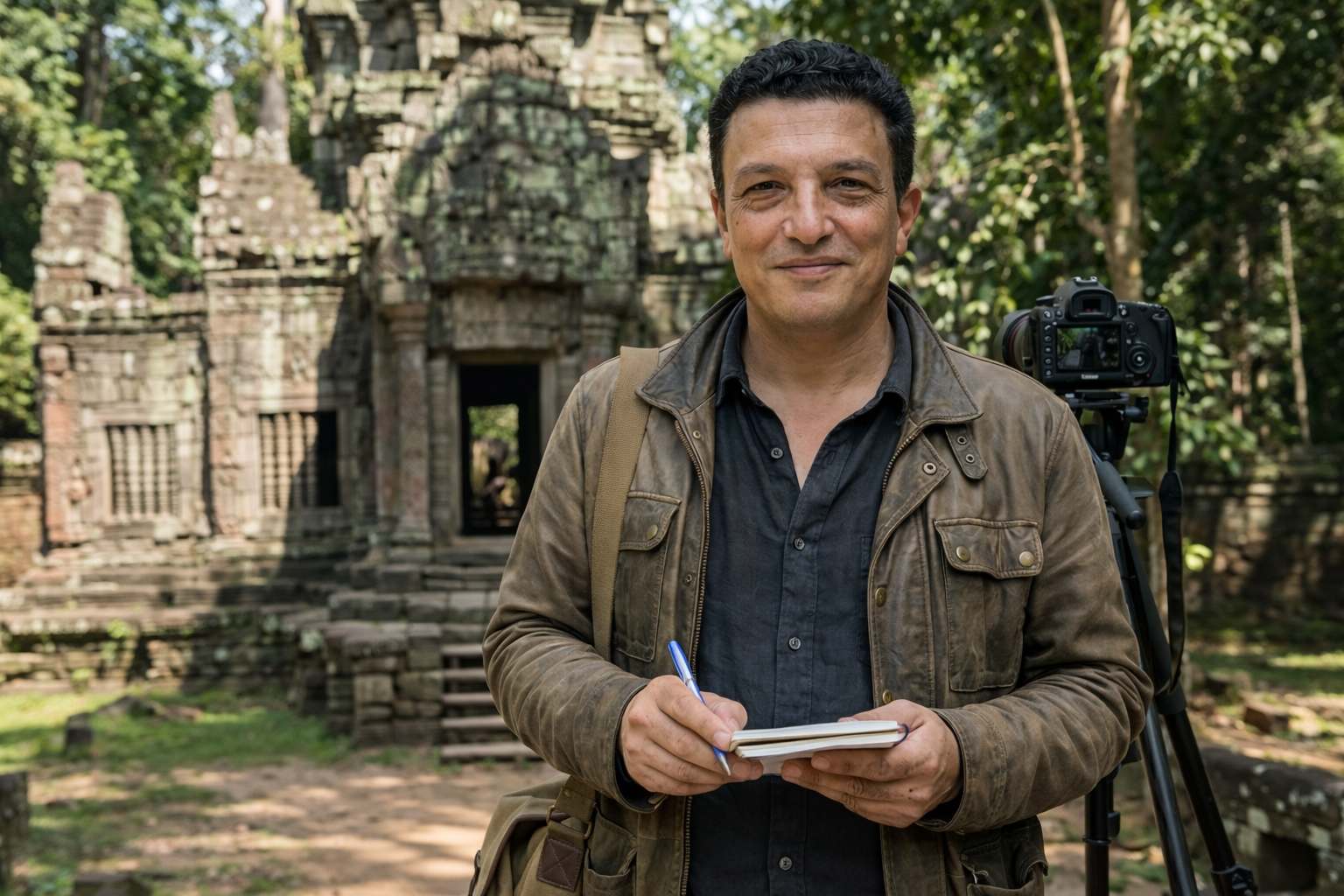
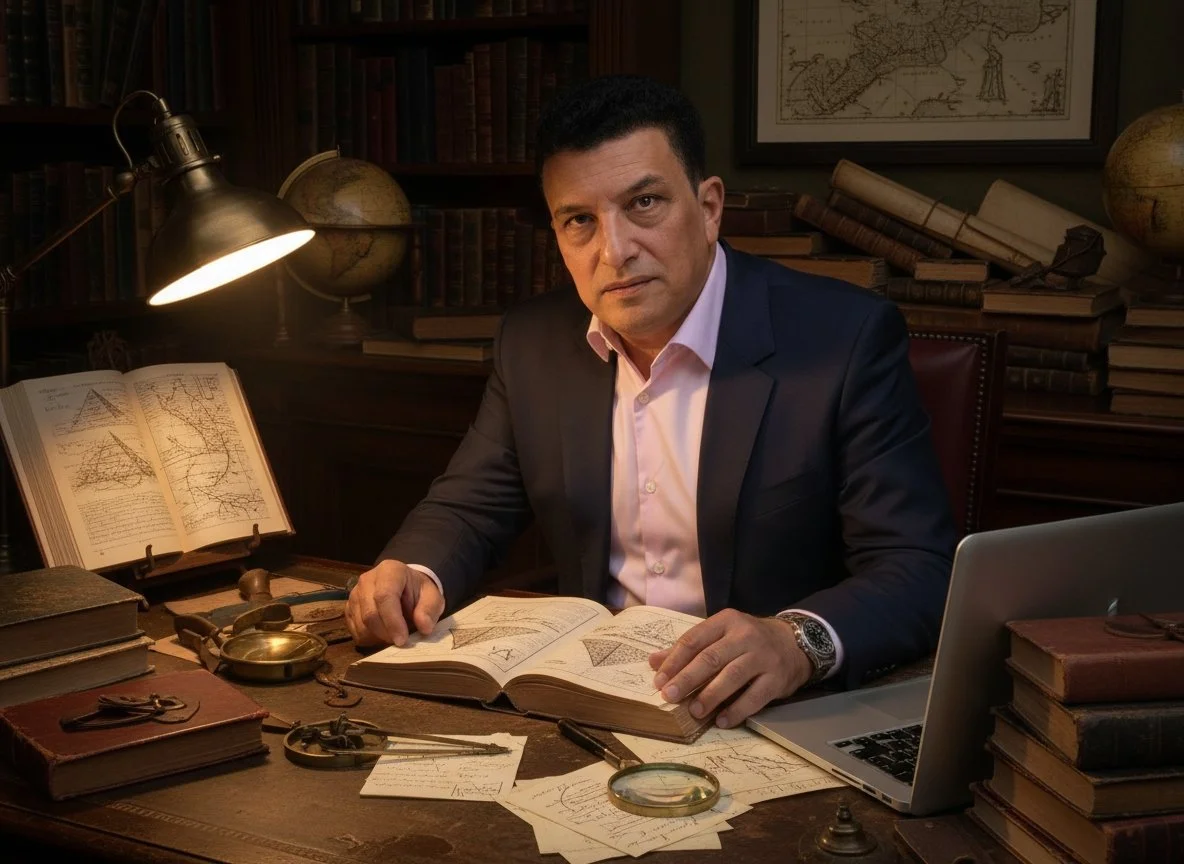
The Author
Rod J. R. Silva was born in Portugal and spent his formative years in Angola, where the vast landscapes and layered histories of Southern Africa left an impression that would shape everything he later wrote. At ten, he returned to Portugal and entered the Instituto Militar dos Pupilos do Exército — one of the country's oldest military educational institutions — beginning a path of discipline, structure, and rigorous attention to detail that would follow him through every career he subsequently chose and a few he invented along the way.
From military school he moved into the Military Police, where he learned two things that proved equally useful in fiction and in life: how institutions really work, and how much of what happens inside them never reaches the official record.
In his late twenties, he made the kind of sharp turn that people who are paying attention to their own restlessness eventually make. He left the military and moved into information technology, building a professional career in an industry where solving complex problems, connecting disparate systems, and asking why does this work this way? became daily practice. The transition from military structure to technology architecture was less of a leap than it appeared — both fields reward the person who can see the pattern beneath the surface and who refuses to accept "that's just how it's done" as an explanation.
He has lived in London for the better part of two decades, but “lives in London” understates the geography. Rod considers himself a citizen of the world in the most literal sense — he has travelled extensively across continents, accumulating the kind of first-hand knowledge of places, cultures, and landscapes that no amount of research can replicate. When the Genesis stories describe the heat of the Indian desert, the silence of a Hopi mesa, the particular quality of light on Lake Geneva, or the weight of walking through a building that has been standing for a thousand years, that specificity comes from boots on the ground, not browser tabs.
Music has been a constant thread. He began DJing as a teenager and still keeps it as a creative outlet — a practice in reading a room, building tension, knowing when to hold a beat and when to drop it. Writers who also DJ tend to understand pacing instinctively, and Rod's prose reflects it: the investigations in the Chronicles build the way a set builds, each story adding a layer, each revelation timed to land when the reader is ready to receive it.
Photography is the other constant — a deep, sustained passion for capturing places, people, and the particular quality of light that a moment holds before it moves on. The camera trained his eye the way the military trained his discipline: to look closely, to frame deliberately, to notice the detail that everyone else walks past. It also fed an abiding fascination with different cultures and traditions — not as a tourist collecting postcards but as someone genuinely drawn to understanding how other civilisations organise their knowledge, honour their dead, mark their seasons, and remember their origins. That fascination runs through every page of the Chronicles. The Hopi elder on Third Mesa, the Kabbalist's hidden room in Safed, the Sanskrit library in Varanasi, the Benedictine monk recording what he saw in the Tuscan sky — these are not exotic backdrops. They are the reason the stories exist. Rod writes about ancient traditions with care because he has spent a lifetime seeking them out, sitting with the people who carry them, and listening with the attention they deserve.
Languages are perhaps the deepest hobby of all. Besides his native Portuguese and his adoptive English, Rod speaks around fourteen languages — collected not as trophies but as keys. He learns them because the stories you hear are more genuine in their original version. A myth retold in translation is a photograph of a photograph; heard in the language it was first told in, it carries inflections, resonances, and structural choices that reveal what the teller actually meant rather than what the translator decided they meant. Koichi Tanaka's obsession with the source language — the orphaned vocabulary sitting inside Sanskrit, the characters that appear across civilisations with no documented contact — comes from a writer who understands in his bones that language is not merely a vehicle for meaning. It is meaning. And the fastest way to understand a culture is to hear it thinking in its own words.
The Influences
The Schiaparelli Institute Chronicles exist at the intersection of two traditions that rarely share shelf space: rigorous alternative history and propulsive thriller fiction.
On one side: the researchers who looked at the ancient world and asked questions that mainstream scholarship preferred not to hear. Erich von Däniken, whose Chariots of the Gods? first proposed that ancient mythologies described real encounters with advanced beings. Graham Hancock, whose work on pre-diluvian civilisations and the deep antiquity of human knowledge challenged the accepted timeline with forensic persistence. Christopher Knight and Alan Butler, whose investigations into ancient measurement systems, Freemasonic geometry, and the transmission of knowledge across millennia demonstrated that the most extraordinary claims can be built on the most meticulous evidence. Robert Lomas, whose exploration of the intersection between Masonic tradition, lost science, and suppressed history showed that institutional secrecy is not conspiracy theory — it is institutional practice. Freddy Silva, whose research into sacred sites, ancient temples, and the relationship between monuments and consciousness opened the door to questions about what the ancient builders actually knew and how they knew it — and whose work on the Knights Templar's enduring influence resonates particularly with Rod, who is a firm believer that Templar knowledge and Templar networks shaped Portugal's history in ways that mainstream historiography has barely begun to acknowledge. The Age of Exploration, the maritime routes, the architecture of the Convento de Cristo in Tomar — for Rod, these carry the fingerprints of a transmission of knowledge that did not end when the Order was officially dissolved in 1312 but continued, through Portugal, into the wider world.
On the other side: the storytellers who understood that the best way to explore an idea is to send characters into it and see what survives. Dan Brown, who demonstrated that esoteric history and page-turning narrative are not opponents but allies — that the general public will engage with Masonic architecture, Vatican secrets, and suppressed knowledge if someone has the craft to make the investigation as compelling as the revelation. José Rodrigues dos Santos, the Portuguese novelist and journalist whose thrillers weave real science, historical scholarship, and geopolitical complexity into narratives that treat the reader as an intelligent adult capable of following an argument across four hundred pages and arriving, breathless, at a conclusion that is simultaneously surprising and inevitable.
The Genesis stories and the eleven-volume main series draw from both traditions. The historical and scientific foundations — the Saqqara Bird, the Piri Reis map, the Sphinx erosion hypothesis, the chromosome 2 fusion, the Kachina traditions, the Nuremberg broadside of 1561, the Voynich Manuscript, the Antikythera Mechanism, the Book of Enoch, the structures on Mars — are real. The investigations, the teams, and the institutional adversary that hunts them are fiction. The space between the two — the space where a real artefact in a real museum becomes the pivot on which a fictional investigation turns — is where the Chronicles live.
Rod writes the kind of books he wants to read: stories where the research is as deep as the plot, where the ancient world is treated with the respect it deserves, and where the question What if they were telling the truth? is pursued not with credulity but with the disciplined, evidence-first methodology of people who understand that the most dangerous thing in the world is not a secret — it is a secret that someone has been keeping on purpose, for a very long time.
Rod J. R. Silva is the author of The Schiaparelli Institute Chronicles — two short story collections and an eighteen-volume investigative thriller series spanning archaeology, conspiracy, consciousness, and the question of what humanity is capable of becoming. He lives in London, travels compulsively, and believes that the ancient world has not yet finished surprising us.