
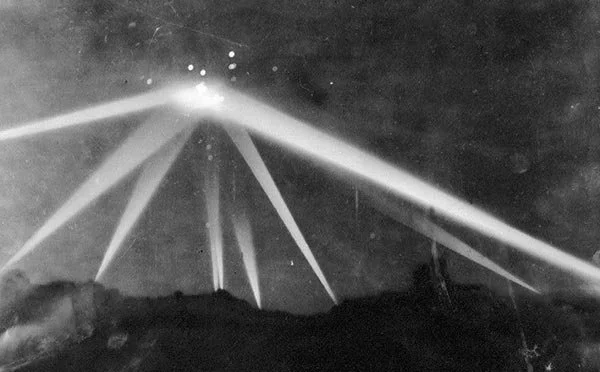
Searchlights converging over Los Angeles (iconic photo, Feb 1942)
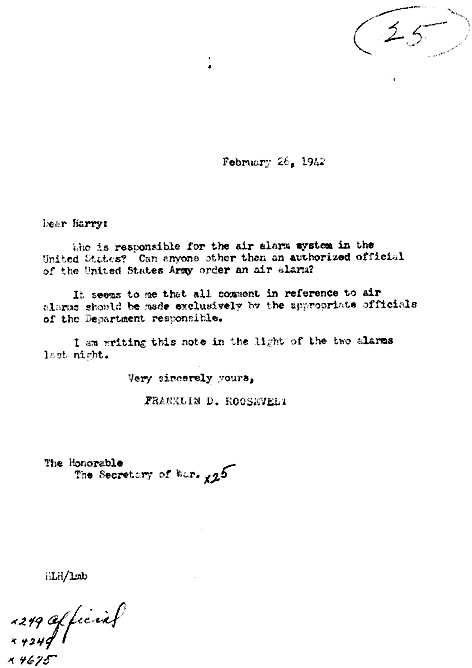
Roosevelt ↔ Stimson memo image referencing the incident
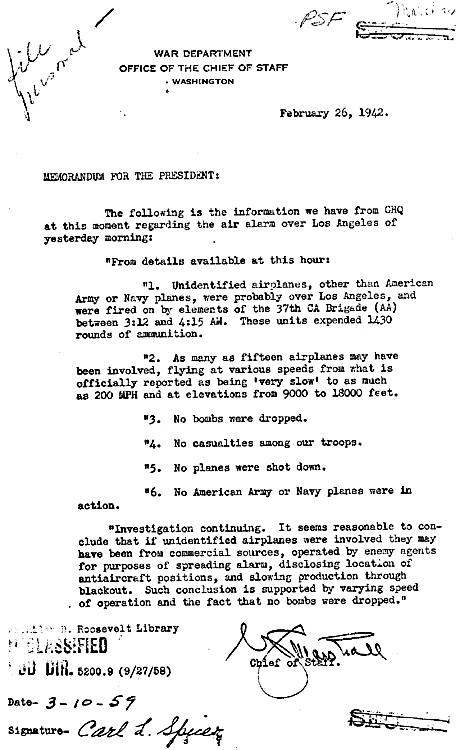
Marshall → Roosevelt memo (Battle of Los Angeles document image)
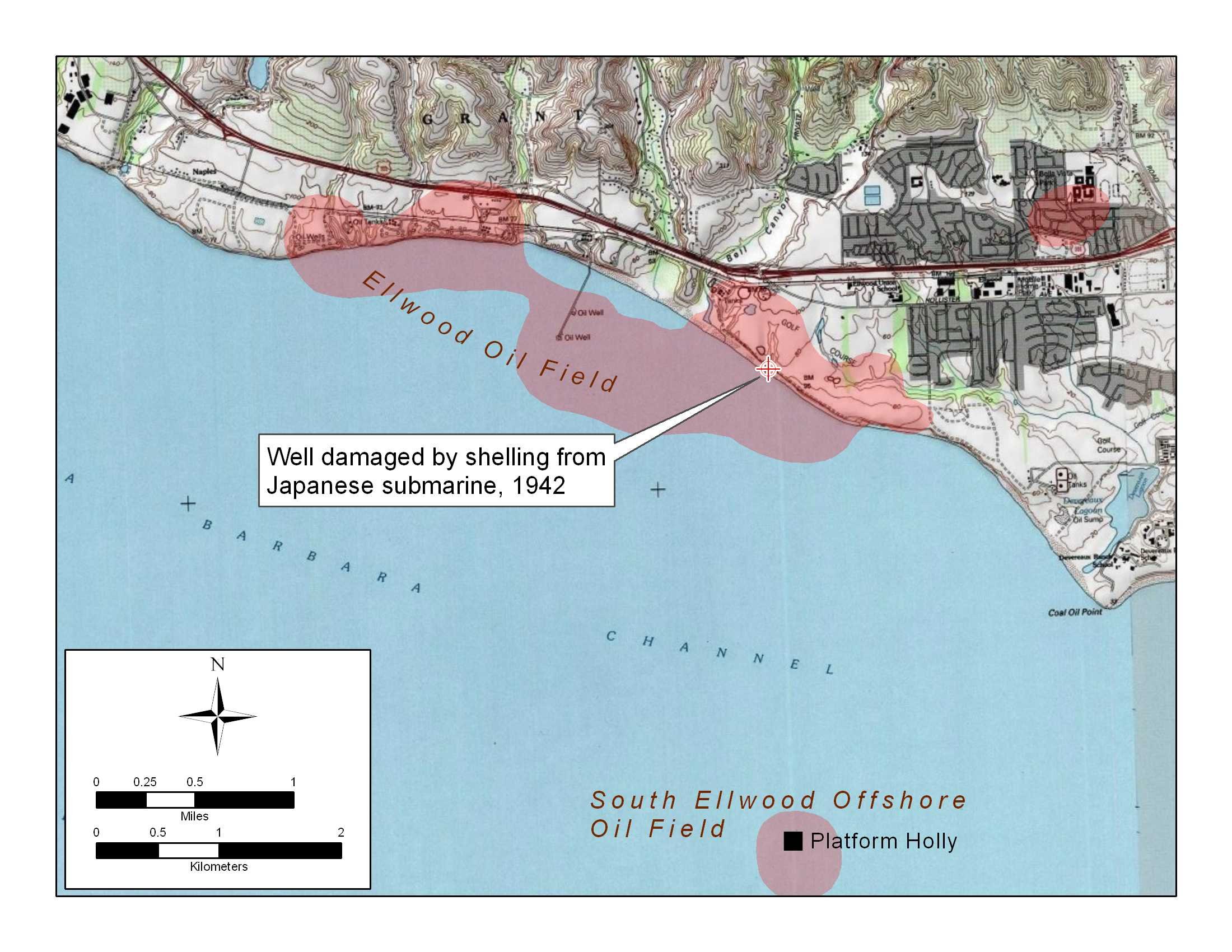
Ellwood shelling context map (damaged well location; Feb 23, 1942)
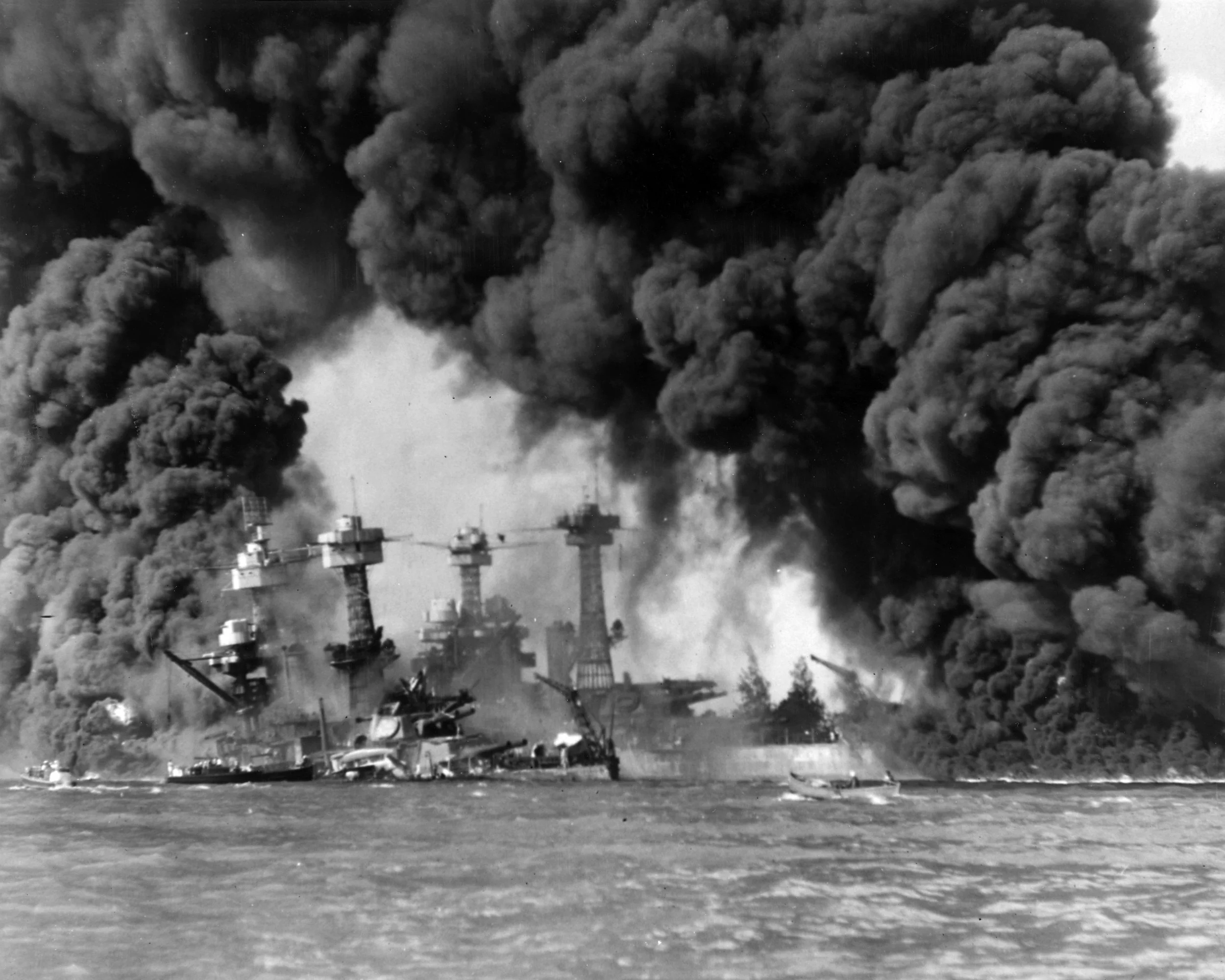
Burning ships at Pearl Harbor (West Virginia & Tennessee in smoke)
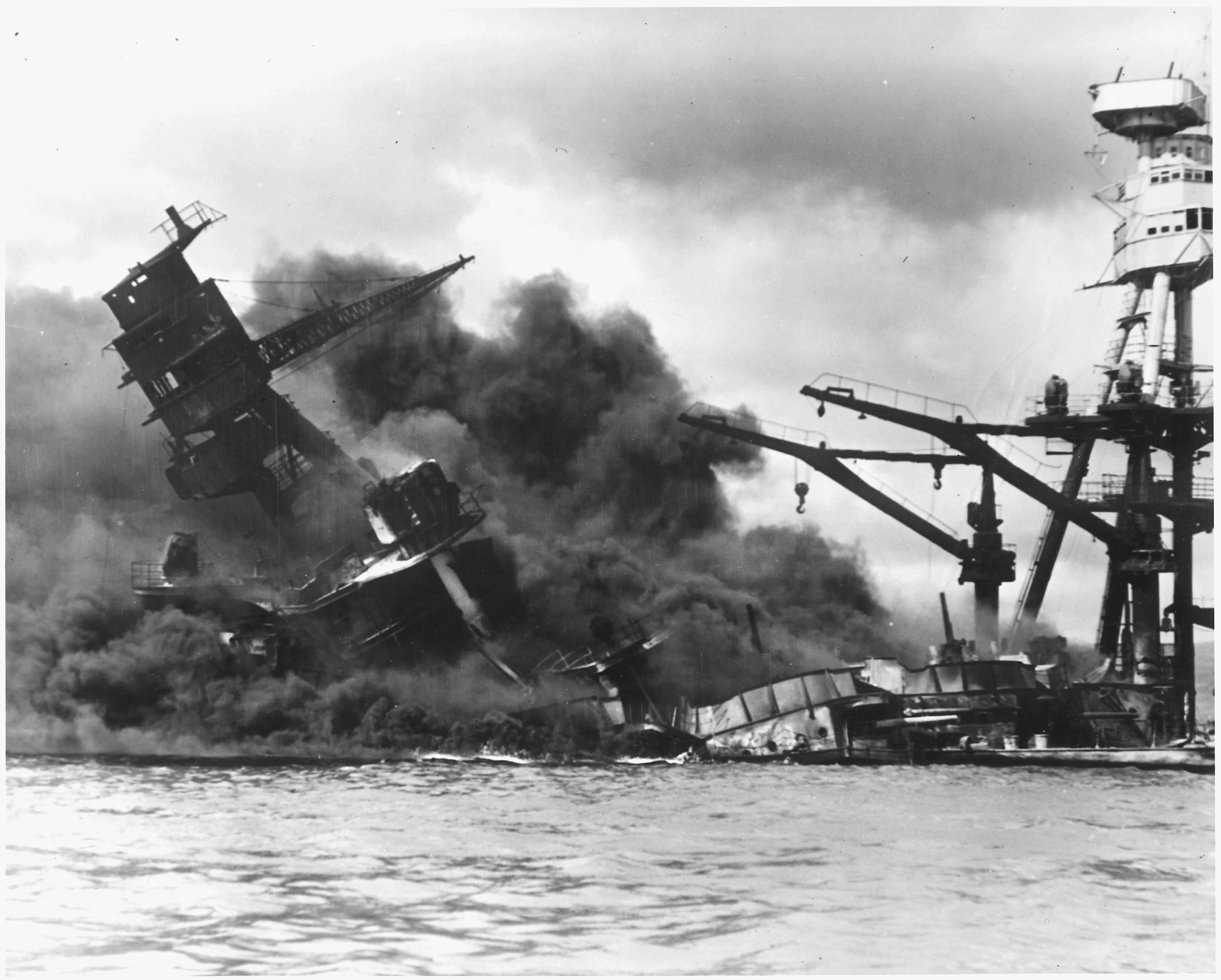
USS Arizona burning (Pearl Harbor attack, Dec 7, 1941)
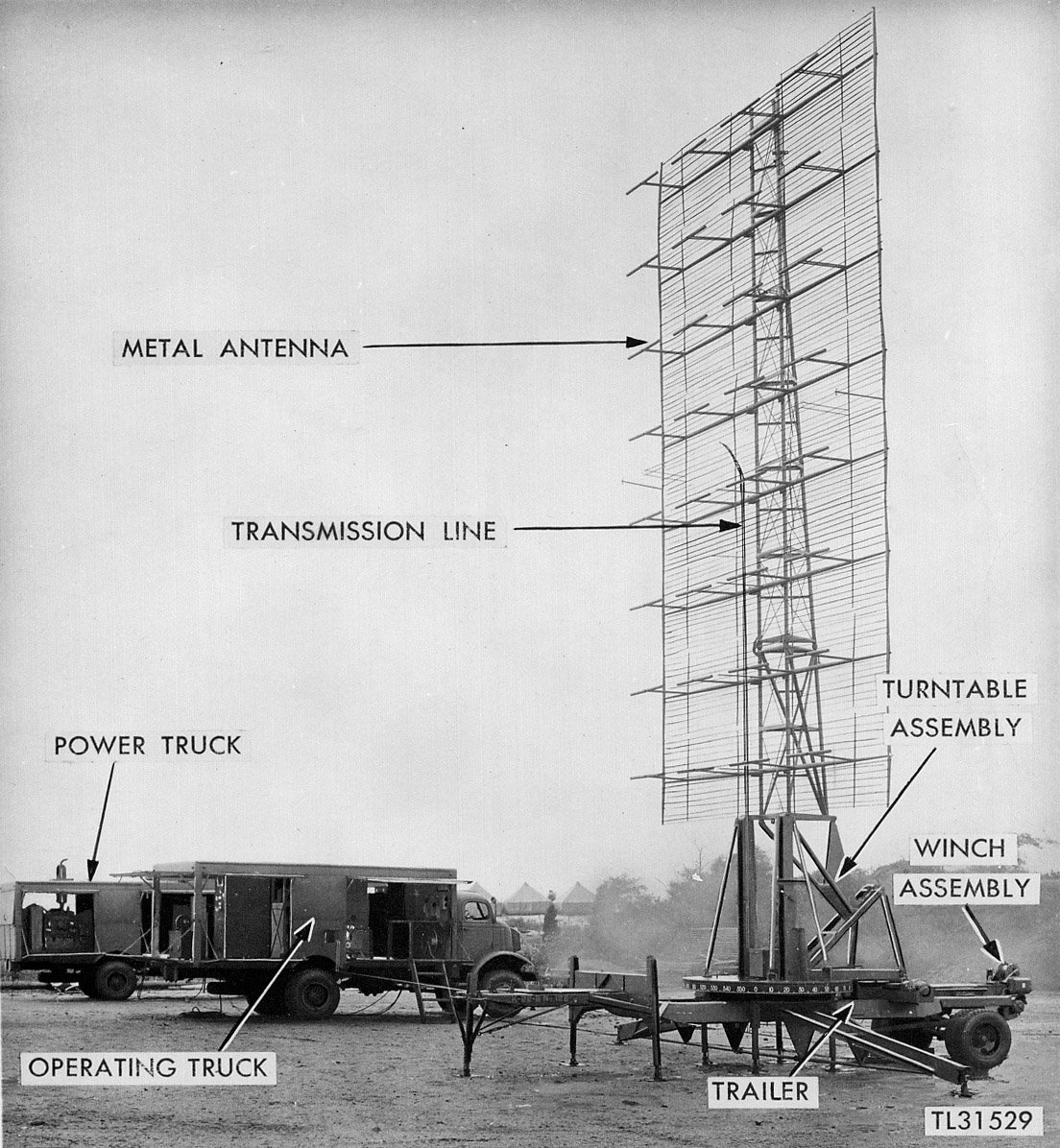
SCR-270 set-up (period photo used as basis for later versions)
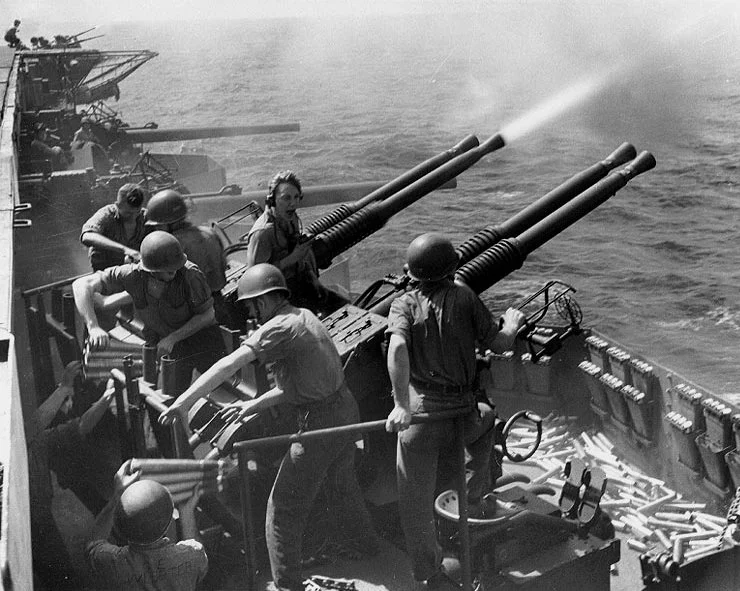
Bofors guns firing (U.S. Navy anti-aircraft practice photo)
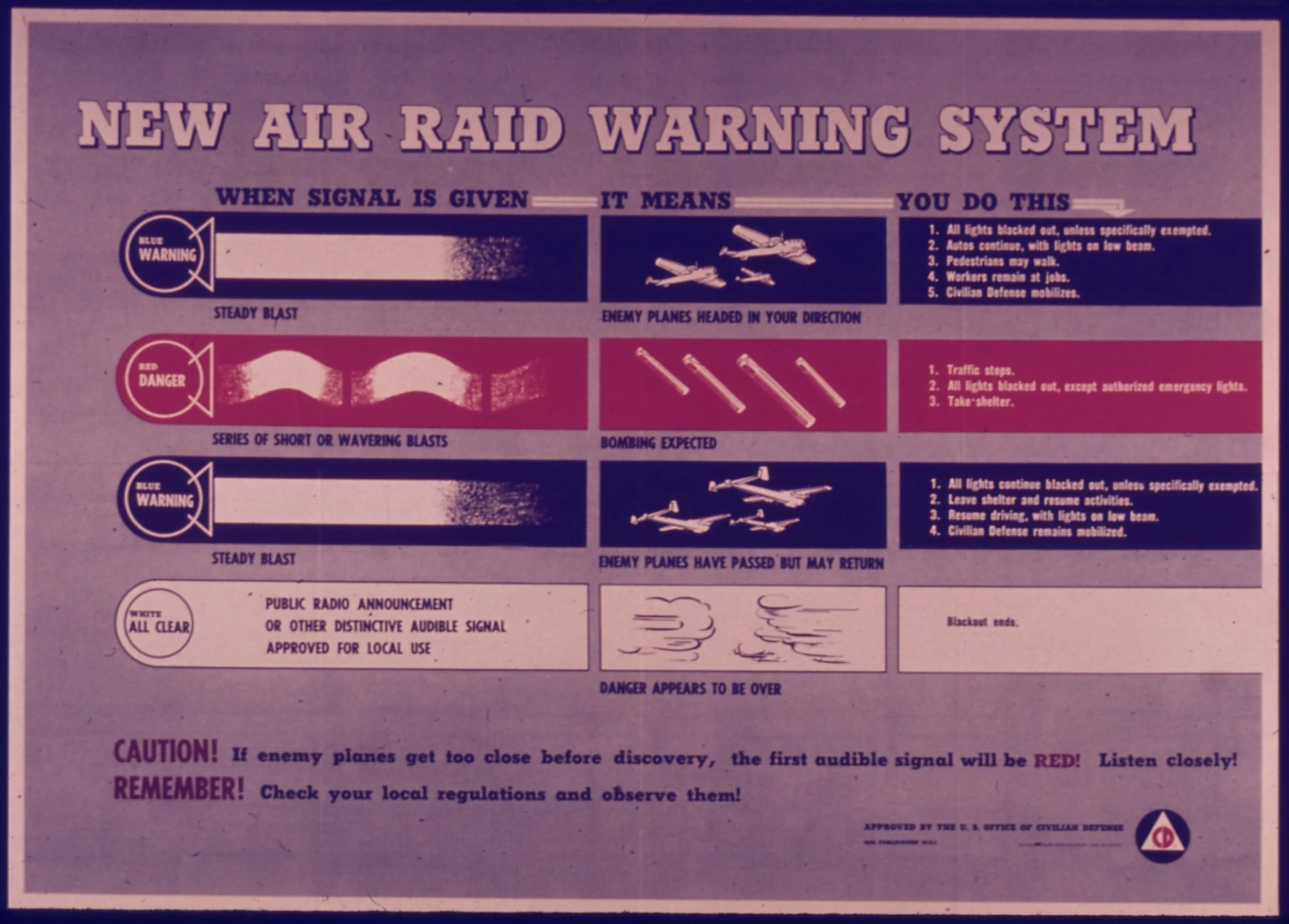
Poster: “New air raid warning system” (how alerts were communicated)
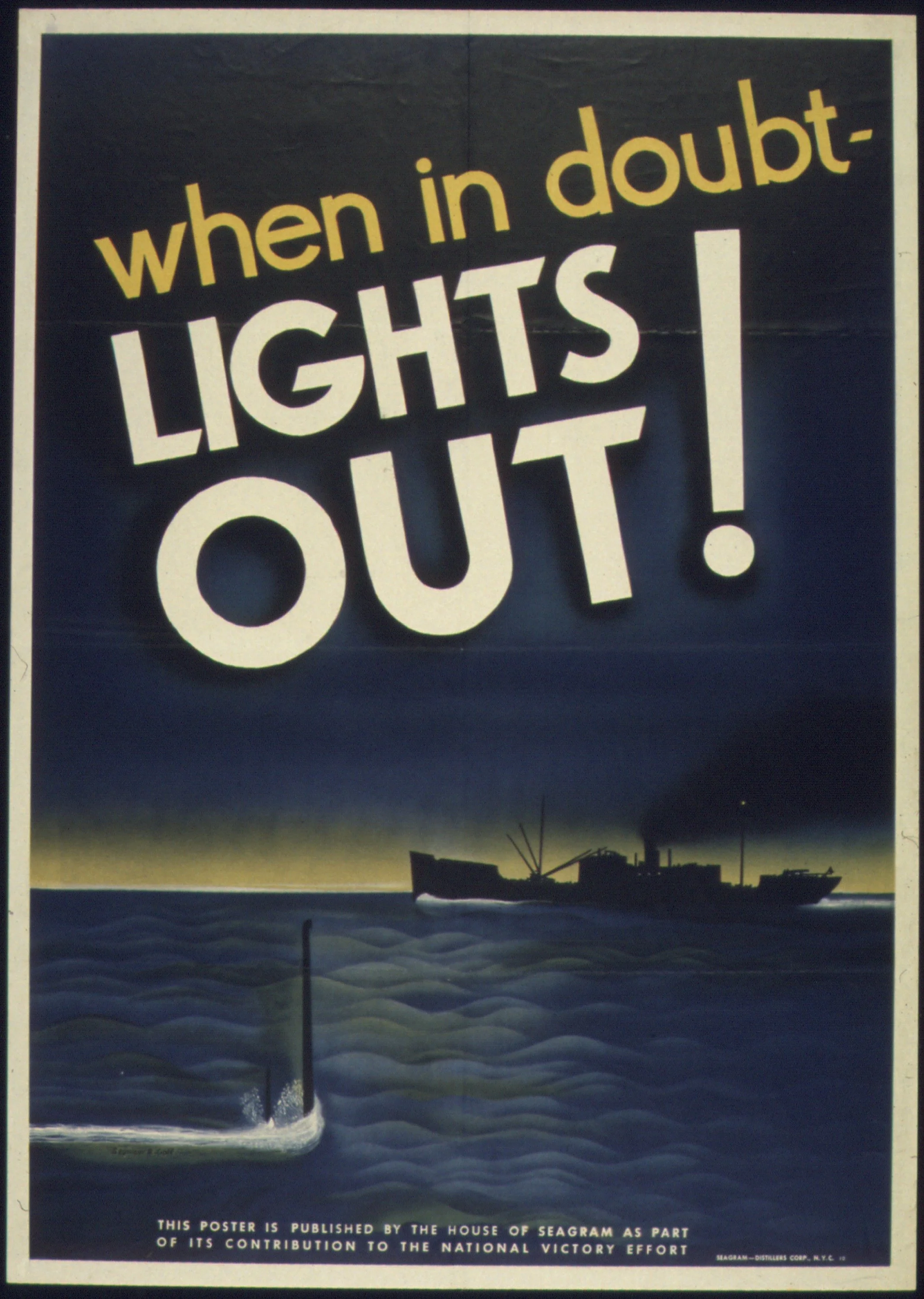
Poster: “WHEN IN DOUBT – LIGHTS OUT” (blackout compliance messaging)
The Battle Of Los Angeles
I. Introduction — A Night of Searchlights and Shadows
In the dark hours before dawn on February 25, 1942, the city of Los Angeles awoke to sirens. It had been barely ten weeks since the Attack on Pearl Harbor thrust the United States into World War II, and the West Coast lived under a constant shadow of expected invasion. Rumours had circulated for days of lights spotted offshore and possible enemy reconnaissance. That night, shortly after 2:00 a.m., radar contacts and visual reports triggered an air raid alert.
Within minutes, the vast metropolis—home to over a million people—was ordered into darkness. Streetlights snapped off. Windows were covered. Traffic halted. The Pacific coast’s largest city disappeared into blackout.
Then came the thunder.
Searchlights pierced the sky in coordinated arcs, converging on indistinct shapes—if shapes there were. Moments later, anti-aircraft batteries opened fire. Shells streaked upward in bright, arcing trajectories, exploding in bursts of orange and white high above the city. For nearly an hour, more than a thousand rounds were fired into the night.
To residents below, the scene felt apocalyptic. The booming of artillery echoed off buildings. Shrapnel fragments rained down on rooftops and streets. Windows shattered. Some civilians believed they could see aircraft silhouettes; others saw only light and smoke. Official confirmation never came.
The spectacle was later immortalized in a dramatic photograph published by the Los Angeles Times, showing converging beams of light illuminating an apparently solid object in the sky—a powerful image that would fuel speculation for decades.
For civilians, the night was one of confusion and fear. Families huddled in hallways and basements. Some fled to makeshift shelters. Others scanned the sky from rooftops, torn between curiosity and dread. Telephone lines were jammed. Rumours spread faster than official information.
Blackout conditions intensified the anxiety. With no streetlights and little reliable news, imagination filled the gaps. The memory of Pearl Harbor was still raw; the possibility of Japanese bombers over California seemed terrifyingly plausible.
By 4:00 a.m., the firing subsided. At approximately 7:00 a.m., the “all clear” was given. Daylight revealed no bomb craters, no wreckage, and no confirmed enemy aircraft. Yet damage was visible—broken windows, damaged roofs, and tragically, several civilian deaths attributed to heart attacks and accidents during the blackout.
In the hours that followed, official statements proved inconsistent. Some military sources hinted at flares or weather balloons; others suggested stray signals or false radar contacts. The War Department eventually characterized the incident as a false alarm.
For many citizens, the explanation felt unsatisfying. How could such an intense and prolonged barrage be triggered by nothing? Why had radar systems, visual observers, and anti-aircraft units all reacted simultaneously?
The event quickly earned an informal name: The Battle of Los Angeles—a battle in which thousands of shells were fired, yet no confirmed enemy was ever identified.
More than eight decades later, the night of February 25, 1942 remains suspended between history and myth. For military historians, it serves as a case study in wartime anxiety, early radar limitations, and command miscommunication. For students of cultural history, it illustrates how fear can transform ambiguity into perceived threat.
For UFO researchers, particularly in the decades following the Roswell incident, the famous searchlight photograph became something else entirely—purported evidence of an unidentified object illuminated in the sky.
Whether viewed as a false alarm, a defensive overreaction, or something more mysterious, the Battle of Los Angeles endures as a vivid reminder of a nation on edge—when shadows in the sky were enough to turn night into war.
II. Historical Context — America on Edge
By early 1942, the United States was a nation transformed almost overnight from uneasy neutrality to full-scale war mobilization. Nowhere was that shift felt more acutely than along the Pacific Coast. California—geographically exposed and economically vital—became a front line in the American imagination.
The Attack on Pearl Harbor on December 7, 1941, was not merely a military strike; it was a psychological shock. The surprise assault by Japanese forces destroyed battleships, killed over two thousand Americans, and shattered the assumption that the continental United States was secure from foreign attack.
President Franklin D. Roosevelt famously described the date as “a day which will live in infamy.” In the weeks that followed, newspapers printed invasion maps, military analysts speculated about coastal vulnerabilities, and radio broadcasts carried warnings about sabotage and espionage. The Pacific Ocean—once perceived as a vast protective barrier—now felt dangerously narrow.
California, Oregon, and Washington were suddenly perceived as potential targets. Military planners openly considered the possibility of submarine attacks, aerial bombardments, or even limited landings along remote stretches of coastline.
These fears were not entirely abstract. Japanese submarines were active in the eastern Pacific, and in February 1942, coastal shelling incidents near Santa Barbara reinforced public anxiety. Even minor sightings of lights or aircraft offshore could trigger intense speculation.
Rumours circulated rapidly. Citizens reported suspicious signals from hilltops, strange boats near harbours, and aircraft lights over the ocean. In this environment, ambiguity easily became perceived threat.
In response, the United States accelerated defensive mobilization. Troop deployments increased along the Pacific Coast. Artillery units were stationed near harbours and industrial sites. Anti-aircraft batteries were installed around major cities, including Los Angeles.
Military readiness became visible in everyday life. Soldiers patrolled beaches. Barrage balloons appeared in some cities. Coastal lookouts scanned the horizon around the clock. The nation had entered a state of defensive vigilance unprecedented in its modern history.
Radar technology, still relatively new in 1942, became a cornerstone of coastal defence. Systems such as the SCR-270 were deployed to detect incoming aircraft at long range. However, these early radar sets were prone to false positives caused by weather patterns, birds, or atmospheric anomalies.
Operators were often inexperienced, and coordination between radar stations and command centres was still evolving. In such a tense climate, ambiguous radar signals were rarely dismissed casually.
Civil defence measures became part of civilian routine. Air raid sirens were installed across major urban areas. Residents were instructed to extinguish lights immediately during alerts to prevent silhouetting the city against the night sky.
Blackout drills were conducted frequently. Businesses practiced rapid shutdown procedures. Households purchased blackout curtains. Schools distributed emergency preparedness pamphlets.
These measures reinforced both readiness and anxiety. The possibility of attack became embedded in daily consciousness.
California’s strategic importance justified large-scale military expansion. Army and Navy installations grew rapidly. Aircraft plants expanded production to unprecedented levels. Ports were fortified, and airfields multiplied across the region.
Troops trained continuously in anti-aircraft operations, coastal defence, and emergency response. Ammunition stockpiles increased. In such an environment, rapid mobilization during an alert—like the one on February 25, 1942—was not only possible but expected.
Authorities established restricted coastal zones to limit civilian access. Curfews were implemented in sensitive areas. Harbour traffic was monitored closely.
The coastline itself became a controlled space, reinforcing the perception that invasion was not merely theoretical but anticipated.
Los Angeles was not just a major city; it was a vital wartime production hub. Aircraft manufacturers such as Douglas Aircraft Company and Lockheed Corporation operated massive facilities in the region, producing bombers, fighters, and transport planes. Shipyards along the coast constructed and repaired naval vessels.
These industrial assets made the city a plausible strategic target. The destruction of Southern California’s manufacturing capacity could have disrupted Allied war production significantly.
Against this backdrop, civilian anxiety flourished. News travelled quickly but not always accurately. Reports of “lights over the ocean” or “enemy submarines offshore” were repeated in homes, workplaces, and newspapers.
In a pre-digital age reliant on radio and print, official clarification often lagged behind rumour. The psychological state of the city was one of readiness mixed with dread—a volatile combination.
The atmosphere of fear also had grave social consequences. On February 19, 1942—just days before the Battle of Los Angeles—President Roosevelt signed Executive Order 9066, authorizing the removal of Japanese Americans from designated military areas.
Although the full internment process was still unfolding, suspicion toward Japanese-American communities had already intensified. The West Coast’s defensive mindset blended military precaution with racial prejudice, a reality that would shape the broader historical context of early 1942.
By the time searchlights swept the Los Angeles sky in the early hours of February 25, 1942, the city was primed for alarm. The combination of recent trauma, technological uncertainty, and relentless rumour had created a climate in which the unexpected could instantly become the catastrophic. The “Battle of Los Angeles” did not erupt in isolation—it was born from a nation on edge.
III. Timeline of Events — February 24–25, 1942
The events that unfolded over Los Angeles between the evening of February 24 and the morning of February 25, 1942, moved rapidly from vague suspicion to full military engagement. The official record, reconstructed from War Department memoranda, naval reports, and contemporary press coverage, reveals a sequence shaped as much by uncertainty as by action.
On the evening of February 24, coastal radar installations began registering intermittent contacts offshore. These returns—often described as “blips”—were indistinct and inconsistent. Operators could not conclusively determine whether the signals represented aircraft, atmospheric interference, or technical anomalies.
Simultaneously, civilian observers along the Southern California coast reported unusual lights at sea. Some described flares; others claimed to see moving points of light in the sky. In the tense atmosphere following the Attack on Pearl Harbor, such reports were rarely dismissed lightly.
By late evening, coastal defence units were placed on heightened alert.
Naval intelligence had already warned of potential Japanese reconnaissance or harassment operations along the West Coast. Japanese submarines had been active in the Pacific, and only days earlier, coastal shelling near Santa Barbara had reinforced fears of offshore threats.
While no confirmed enemy aircraft were identified, the accumulation of radar signals and visual reports triggered precautionary measures. Military commanders faced a dilemma: risk complacency or respond decisively.
In the early hours of February 25—shortly after 2:00 a.m.—authorities issued a citywide blackout order for Los Angeles and surrounding areas. Lights across the metropolis were extinguished within minutes. Streetlamps went dark. Homes shuttered windows. Factories dimmed their operations.
The objective was tactical: prevent silhouetting the city against the night sky in case of aerial bombardment.
Air raid sirens pierced the darkness. The wail echoed through neighbourhoods, industrial districts, and coastal communities. Civil defence wardens moved quickly through streets to enforce compliance.
Radio stations interrupted programming to broadcast instructions. Residents were told to remain indoors, avoid using telephones unless necessary, and await further information.
For many, it was the first real test of wartime preparedness.
Traffic halted abruptly. Streetcars stopped mid-route. Private vehicles pulled to the curb. Nonessential public services were suspended.
The city, usually illuminated and bustling even at night, became a vast expanse of shadow—tense and expectant.
At approximately 3:00 a.m., anti-aircraft batteries opened fire. Searchlights swept the sky, converging on points that gunners believed marked aerial targets.
Over the next hour, more than 1,400 shells were reportedly fired into the darkness. Explosions burst high above the city in brilliant flashes. The concussive booms reverberated across neighbourhoods, shaking windows and rattling rooftops.
The barrage continued intermittently until around 4:00 a.m. Units adjusted aim repeatedly as searchlights tracked perceived movement. Despite the intensity of fire, no confirmed aircraft were shot down.
Military coordination was complicated by limited radar precision and the difficulty of visual confirmation in night time conditions.
Residents described a surreal spectacle: intersecting beams of light illuminating drifting smoke; artillery bursts sparkling like artificial stars; debris falling silently after explosions.
Some witnesses insisted they saw dark shapes moving against the sky. Others reported only light and confusion. Fear amplified perception. With memories of Pearl Harbor still vivid, many assumed the worst—that Japanese bombers were overhead.
The following day, dramatic images appeared in the Los Angeles Times, including a now-famous photograph of converging searchlights seemingly focused on a single illuminated object.
The image would later become one of the most reproduced visual artifacts of the incident, fuelling both historical debate and, decades later, UFO speculation.
Shortly after 4:00 a.m., firing ceased. By approximately 7:00 a.m., authorities issued the “all clear.” Lights gradually returned. Traffic resumed. Radio broadcasts shifted from emergency instructions to official explanations.
The city emerged from darkness into uncertain daylight.
Military statements acknowledged that no confirmed enemy aircraft had been recovered or positively identified. Initial speculation ranged from stray flares to weather balloons to false radar contacts.
The War Department later characterized the episode as a false alarm. Yet the scale of the response raised questions that lingered long after the smoke cleared.
Fragments of anti-aircraft shells fell across residential neighbourhoods. Buildings sustained roof damage. Windows shattered. Streets were littered with metallic debris.
The physical damage was limited compared to what might have occurred during an actual bombing—but it was tangible proof of the night’s intensity.
Although no bombs fell, the event was not without tragedy. Several civilian deaths were attributed indirectly to the incident, including heart attacks triggered by stress and accidents occurring during blackout conditions.
Thus ended what newspapers soon dubbed the “Battle of Los Angeles”—a battle marked by thousands of shells, a sky ablaze with searchlights, and an enemy that, officially at least, had never been there.
IV. Official Explanations and Government Response
In the hours and days following the night of February 24–25, 1942, the battle shifted from the sky to the press room. If anti-aircraft fire had dominated the darkness, public statements and official memoranda now shaped the daylight narrative. What authorities said—and how they said it—would determine whether the episode was remembered as a genuine defensive engagement or an embarrassing overreaction.
Immediately after the “all clear,” confusion reigned not only among civilians but within the military command structure itself. Preliminary reports were cautious and inconsistent. Some officers suggested that enemy aircraft had indeed been detected and engaged. Others admitted that no confirmed visual identification had been made.
Communications between local defence units, regional commands, and federal authorities were fragmented. Radar operators had reported contacts. Searchlight crews believed they had tracked moving objects. Anti-aircraft gunners had responded accordingly. Yet no wreckage, no bomb craters, and no confirmed enemy losses were found.
The absence of physical evidence created an uncomfortable gap between action and proof.
Tension emerged between branches of the armed forces. U.S. Navy officials reportedly expressed scepticism about the existence of hostile aircraft, suggesting the episode may have been a false alarm triggered by stray flares or meteorological phenomena.
Army commanders, responsible for coastal air defence, initially appeared more inclined to treat the incident as a legitimate engagement based on radar contacts and visual reports.
These differing interpretations reflected broader coordination challenges in early 1942. The United States had mobilized rapidly after the Attack on Pearl Harbor, but joint command structures were still evolving. The result was a public narrative that lacked coherence in its first crucial hours.
Within days, the United States Department of War issued a more definitive statement. The incident, it concluded, had most likely been caused by weather balloons, stray flares, or other non-hostile aerial objects misidentified under blackout conditions.
The official explanation emphasized the limitations of early radar systems and the heightened sensitivity of defence units in a time of war. No confirmed Japanese aircraft were found to have been over Los Angeles that night.
Ultimately, the event was characterized as a “false alarm.” The War Department framed the barrage as a necessary precaution in a climate of legitimate threat rather than a reckless or panicked response.
This phrasing was deliberate. By describing the event as an overabundance of caution rather than a blunder, officials aimed to preserve public confidence in the nation’s defensive readiness. In wartime, projecting vigilance was almost as important as projecting accuracy.
Newspapers across California carried dramatic headlines. The Los Angeles Times published striking photographs of searchlights converging on the night sky, reinforcing the visual impression of a tangible target.
Some headlines suggested an attempted enemy raid repelled by American defences. Others emphasized uncertainty. The language varied—“air raid,” “enemy lights,” “false alarm”—reflecting the unsettled nature of official statements.
The imagery, however, was unequivocal: beams of light, bursts of artillery fire, and a city under siege.
Government officials sought to reassure the public that defences were functioning properly. The rapid mobilization and sustained fire were presented as proof of readiness.
At the same time, the inability to identify a concrete enemy created an aura of unresolved mystery. The contrast between the scale of the response and the absence of evidence was difficult to reconcile.
This dual tone—confidence in defence paired with ambiguity about threat—left space for speculation.
For many citizens, the explanation felt incomplete. How could more than a thousand shells be fired at nothing? Why had radar contacts and searchlights aligned so convincingly if no aircraft were present?
Although most Americans accepted the official account in the context of wartime caution, scepticism lingered beneath the surface. Decades later, especially after the Roswell incident and the rise of UFO culture, the episode would be reinterpreted by some as evidence of something far more extraordinary.
In the immediate aftermath, however, the government’s position was clear: there had been no enemy attack—only vigilance carried to its extreme. The Battle of Los Angeles was officially closed, even if not fully understood.
V. Competing Theories and Interpretations
The absence of confirmed enemy aircraft did not end debate over the events of February 24–25, 1942. Instead, it opened a space for competing interpretations—some grounded in conventional military analysis, others in cultural mythology. Over the decades, the “Battle of Los Angeles” has become less a settled historical incident than a case study in how uncertainty breeds theory.
One of the earliest explanations proposed that Japanese forces had launched reconnaissance aircraft from submarines operating off the California coast. Japan did possess submarines capable of carrying small floatplanes, which could be assembled and launched for limited-range scouting missions.
The notion seemed plausible in early 1942. Only days before the incident, Japanese submarine activity had been confirmed along the West Coast. In that atmosphere, the idea of a brief aerial reconnaissance over Los Angeles did not appear far-fetched.
Some contemporaries speculated that aircraft might have approached, triggered defensive fire, and withdrawn without bombing—either as a probing action or aborted mission.
Imperial Japanese Navy submarines such as the I-class vessels were equipped in some cases with small floatplanes. These aircraft, however, had limited payload capacity and operational range. Launching such a craft near Los Angeles would have required precise coordination and favourable conditions.
Military historians have examined Japanese naval records extensively. While submarine patrols did occur along the Pacific Coast in early 1942, the logistical feasibility of a coordinated aerial reconnaissance over a major urban centre remains debated.
Perhaps the strongest argument against the Japanese attack theory is the absence of corroborating documentation in Japanese military archives. No operational orders, after-action reports, or pilot accounts confirm a February 25 aerial mission over Southern California.
Given Japan’s meticulous wartime record-keeping, historians generally consider the lack of evidence significant. While not definitive proof of absence, it weakens the theory considerably.
The explanation ultimately endorsed by the United States Department of War suggested that weather balloons, stray flares, or similar non-hostile aerial objects triggered the defensive response.
Weather balloons were routinely released for meteorological observation. Under searchlight illumination, drifting balloons could appear as luminous objects moving slowly across the sky—particularly through haze or smoke.
Stray flares from coastal exercises could also have created temporary light sources mistaken for aircraft.
Radar technology in early 1942 was still developing. Systems such as the SCR-270 could detect distant objects but were prone to false positives caused by atmospheric anomalies, sea clutter, birds, or temperature inversions.
Operators were under intense psychological pressure in the wake of the Attack on Pearl Harbor. In such conditions, ambiguous signals were more likely to be interpreted as hostile contacts.
Radar uncertainty combined with visual ambiguity may have created a feedback loop: radar suggested presence; searchlights searched; drifting objects appeared; anti-aircraft batteries responded.
Weather conditions that night included haze and cloud layers capable of diffusing light and magnifying optical illusions. Searchlight beams converging on smoke or cloud fragments could produce the appearance of solid shapes.
This explanation aligns with known environmental effects and technological limitations. For most mainstream historians, it remains the most plausible account.
Another interpretation frames the event as a cascading misinterpretation. A flare—whether civilian, military, or meteorological—might have been mistaken for an enemy signal. Once one unit responded, others followed.
In wartime defence systems, reaction often spreads rapidly. If one battery opens fire, neighbouring units may assume confirmation has occurred.
Early-war command structures were not yet fully integrated. Coordination between radar operators, visual observers, anti-aircraft units, and central command was imperfect.
A single erroneous report could propagate through the system, leading to large-scale mobilization without solid confirmation. In this interpretation, the “Battle of Los Angeles” becomes less a mystery than an example of institutional growing pains under wartime stress.
After the Roswell incident, public interest in unidentified flying objects surged dramatically. Earlier ambiguous aerial events were re-examined through a new cultural lens.
The 1942 searchlight photograph—showing beams apparently converging on a luminous object—became a focal point for reinterpretation. What wartime officials had described as flares or balloons, later UFO researchers viewed as evidence of extra-terrestrial craft.
The dramatic image published in the Los Angeles Times has been reproduced in countless UFO books and documentaries. Cropped or enhanced versions often emphasize the apparent solidity of the illuminated object.
Critics argue that the image’s appearance is easily explained by light diffusion in smoke or cloud. Supporters claim the convergence pattern suggests a physical target.
The photograph’s ambiguity ensures its endurance.
By the 1950s and 1960s, the “Battle of Los Angeles” had entered UFO folklore. Television programs, books, and later internet forums framed the event as a possible early extra-terrestrial encounter.
While most professional historians reject this interpretation, its persistence highlights the cultural power of unresolved imagery. The episode has become a bridge between wartime history and modern mythmaking.
In sum, the competing theories surrounding the Battle of Los Angeles reflect more than disagreement over facts. They reveal how technology, fear, incomplete evidence, and evolving cultural narratives can transform a single night’s confusion into a lasting historical enigma.
VI. Military Technology and Radar Limitations
The events of February 24–25, 1942 cannot be understood without examining the technological environment in which they occurred. The United States had entered World War II only weeks earlier. Radar was still a relatively new system. Coastal air defence networks were expanding rapidly but remained imperfectly integrated. The “Battle of Los Angeles” unfolded at the intersection of emerging technology and intense psychological pressure.
The primary long-range radar deployed along the American coastline in early 1942 was the SCR-270 radar. Developed before U.S. entry into the war, the system could detect large aircraft formations at ranges exceeding 100 miles under ideal conditions.
The SCR-270 operated using pulsed radio waves that reflected off distant objects. Operators interpreted these reflections—displayed as blips on cathode-ray screens—to estimate range and bearing. However, altitude determination was imprecise, and target identification was impossible. Radar could suggest presence, not identity.
The system had already demonstrated both promise and limitation during the Attack on Pearl Harbor, where radar operators detected incoming Japanese aircraft but failed to convince command authorities of the threat in time.
In early 1942, radar interpretation was as much art as science. Operators required training and experience to distinguish genuine aircraft echoes from atmospheric interference.
Temperature inversions, cloud formations, birds, and even ocean waves could produce ambiguous signals. Range estimates could fluctuate. Weak returns might appear and disappear unpredictably. In the tense defensive posture of the West Coast, ambiguous signals were often treated conservatively—as potential threats.
Radar’s inability to confirm visual details meant that searchlights and observers were essential for validation. This created a dependency chain: radar detection prompted visual search; visual ambiguity reinforced radar suspicion.
Coastal environments posed particular challenges. Sea clutter—radio reflections from waves—could create erratic echoes. Weather balloons launched for meteorological tracking were also capable of generating radar returns.
In such an environment, false positives were not rare. The crucial factor was interpretation. Under peacetime conditions, operators might have dismissed certain returns as anomalies. In February 1942, with invasion fears high, caution favoured escalation.
Air defence units around Los Angeles were equipped primarily with 3-inch and 37mm anti-aircraft guns, supported by searchlight batteries and sound locators. These weapons were designed to fire high-explosive shells equipped with timed fuses that detonated at predetermined altitudes.
The goal was not necessarily a direct hit but fragmentation damage within the vicinity of a target aircraft.
Night time engagements significantly reduced accuracy. Gunners relied heavily on searchlight illumination and radar guidance to estimate altitude and direction. Without clear visual confirmation, shells were fired into projected trajectories based on calculations.
Even under optimal conditions, anti-aircraft fire in World War II was statistically unlikely to achieve consistent direct hits. When the target itself was uncertain—as may have been the case during the Battle of Los Angeles—the probability of effective engagement decreased further.
Nevertheless, once firing began, batteries often continued to adjust aim based on perceived movement in the sky, reinforcing the impression of a moving target.
Anti-aircraft shells that failed to detonate at altitude eventually fell back to earth as shrapnel or unexploded fragments. In a dense urban area, this posed serious risks.
During the February 25 incident, falling debris damaged homes, shattered windows, and contributed to civilian injuries. The paradox of air defence became evident: protection from hypothetical bombing introduced real danger from defensive fire.
In early 1942, coordination between the U.S. Army (responsible for coastal air defence) and the U.S. Navy (responsible for offshore operations) was still evolving. Joint command structures were improving but not yet seamless.
During the incident, differing assessments reportedly emerged between Army and Navy officials. The Army, relying on radar contacts and visual reports, treated the situation as an active threat. Naval authorities were more sceptical about confirmed enemy presence offshore.
Such discrepancies complicated decision-making. Without unified command protocols, interpretation varied across branches.
Civil defence networks, though increasingly organized, were also relatively new. Blackout enforcement depended on rapid communication between military authorities, municipal officials, and volunteer wardens.
On the night of February 25, the blackout was executed swiftly—evidence of preparedness. Yet communication gaps between radar stations, artillery units, and command headquarters likely contributed to the duration of the barrage.
Information travelled through multiple channels: radar reports to command posts, searchlight observations to artillery batteries, and military directives to civilian authorities. Each transmission introduced potential delay or distortion.
The technological environment of early 1942 was one of rapid innovation under pressure. Radar offered unprecedented early warning capability, yet it lacked precision. Anti-aircraft systems provided visible defensive power, yet carried inherent risks. Communication networks enabled swift mobilization, yet remained imperfectly synchronized.
The “Battle of Los Angeles” thus stands not only as a historical mystery but also as a revealing moment in the maturation of modern air defence—a night when emerging technology met wartime fear, and uncertainty became action.
VII. Social and Political Consequences
The Battle of Los Angeles was brief in duration, but its social and political consequences extended far beyond the early morning hours of February 25, 1942. Though no enemy aircraft were confirmed, the event left visible damage, reinforced national anxieties, and intensified policies already reshaping American society in wartime.
No bombs fell on Los Angeles that night. Yet the incident was not without human cost. Several civilian deaths were reported in the aftermath, most commonly attributed to heart attacks triggered by stress during the blackout and barrage.
The psychological strain of sirens, explosions, and darkness—coming only weeks after the Attack on Pearl Harbor—proved overwhelming for some residents. Others were injured in accidents during the blackout, including falls and traffic collisions that occurred when lights were extinguished.
While the number of casualties was small compared to wartime battlefields, the irony was stark: the only confirmed fatalities resulted not from enemy action but from defensive measures.
More than 1,400 anti-aircraft shells were fired into the night sky. Those that failed to detonate aloft eventually descended as metal fragments. Roofs were punctured. Windows shattered. Vehicles and storefronts sustained damage.
Photographs and newspaper reports from the following day documented scattered debris across neighbourhoods. Although the overall destruction was limited, it served as tangible proof that the city had, in effect, bombarded itself.
The incident exposed a troubling reality of modern air defence: protection against perceived threats could generate real hazards on the ground.
The barrage occurred during an already volatile period of suspicion along the Pacific Coast. Rumours of sabotage, espionage, and invasion circulated widely. The spectacle of artillery fire over Los Angeles seemed, to many, confirmation that the threat was immediate and real.
Even though officials later described the episode as a false alarm, the intensity of the response reinforced the perception that California was vulnerable. Public fear did not subside easily.
Just six days before the incident, President Franklin D. Roosevelt had signed Executive Order 9066, authorizing the forced relocation of Japanese Americans from designated military areas.
Although the decision to implement internment had already been made, the Battle of Los Angeles occurred at a critical moment in public opinion. The dramatic anti-aircraft barrage strengthened arguments by those who claimed the West Coast faced imminent danger.
In retrospect, historians view the episode as part of the broader climate of wartime fear that enabled internment policy to proceed with relatively limited resistance. The combination of military alertness and public anxiety blurred the line between precaution and prejudice.
The incident deepened a sense of vulnerability that had gripped the nation since December 1941. If artillery could erupt over a major American city without confirmed targets, then uncertainty itself had become a source of threat.
Reports of lights in the sky, unusual radio signals, or suspicious activity continued in the months that followed. The boundary between rumour and evidence grew thin in an environment conditioned to expect danger.
This heightened paranoia shaped daily life. Coastal residents remained alert to sirens. Blackout drills were taken seriously. Suspicion of outsiders intensified.
Paradoxically, the episode also strengthened confidence in defensive readiness. From one perspective, the rapid mobilization demonstrated that coastal defences were operational and responsive.
Civil defence organizations expanded. Blackout compliance improved. Air raid drills became more structured and frequent.
The Battle of Los Angeles thus functioned both as a cautionary tale and as a rehearsal. It revealed the fragility of perception under stress, but it also tested and refined the mechanisms of wartime mobilization.
In social and political terms, the incident amplified trends already underway: fear of invasion, acceptance of extraordinary security measures, and willingness to subordinate civil liberties to national defence. The searchlights that pierced the Los Angeles sky illuminated not only drifting clouds and falling shrapnel—but the anxieties of a nation adjusting to total war.
VIII. Media, Memory, and Myth
Historical events do not survive on documentation alone. They persist through images, headlines, retellings, and reinterpretations. The Battle of Los Angeles is remembered less for what was conclusively proven than for what was dramatically seen—or believed to have been seen—on the night sky over Los Angeles.
The most enduring visual artifact of the incident appeared in the pages of the Los Angeles Times the following morning. The image shows multiple searchlight beams converging on a bright patch in the sky, surrounded by bursts of anti-aircraft fire.
Whether the illuminated shape was smoke, cloud, flare, or photographic artifact, the composition suggested a target—something solid and central. The geometry of the beams gave the impression of intentional focus. For readers scanning the paper at breakfast tables across Southern California, the image implied confrontation.
Photographs often outlive their captions. Over time, the picture detached from its original context and became symbolic rather than evidentiary.
Visual imagery condensed a chaotic night into a single, arresting frame. Thousands of words of explanation could not compete with the stark drama of searchlights and explosions suspended in darkness.
In wartime, newspapers walked a narrow line between reassurance and alarm. The image conveyed readiness—American guns firing in defence—but it also reinforced the sense of invasion narrowly avoided.
As decades passed, reproductions of the photograph were frequently cropped, contrast-enhanced, or recontextualized. Each reproduction subtly reshaped interpretation. The image became not just documentation, but iconography.
After the Roswell incident ignited widespread fascination with unidentified flying objects, earlier ambiguous aerial events were revisited through a new cultural lens.
The Battle of Los Angeles fit neatly into emerging UFO narratives: a luminous object in the sky, intense military response, no official confirmation, and a government explanation deemed unsatisfying by some observers.
Throughout the 1950s and 1960s, UFO researchers and writers incorporated the 1942 photograph into books and lectures. In these retellings, the illuminated object was sometimes described as a structured craft. The absence of wreckage became, paradoxically, part of the intrigue.
The Cold War climate—marked by secrecy, classified technology, and distrust of official narratives—amplified these reinterpretations.
By the late twentieth century, the incident had entered broader popular culture. It appeared in television programs exploring unsolved mysteries and wartime anomalies. Science fiction writers referenced it as inspiration for stories blending military defence and extra-terrestrial encounter.
The title itself—“Battle of Los Angeles”—carried cinematic resonance. Though unrelated in plot, the 2011 film Battle: Los Angeles drew on the evocative phrase, demonstrating how the historical episode had embedded itself in cultural memory.
In this stage of reinterpretation, the line between documented event and imaginative elaboration grew increasingly fluid.
In recent decades, historians have revisited the incident with access to declassified military documents and broader wartime archives. Most professional analyses emphasize technological limitations—early radar inaccuracies, visual misidentification, and the psychological climate following the Attack on Pearl Harbor.
Scholars frame the episode as a revealing case study in wartime defence systems under stress. Rather than a mystery of unknown craft, it becomes a narrative about human perception and institutional readiness during crisis.
Despite scholarly consensus favouring conventional explanations, mystery-oriented narratives remain active. Documentary programs often present the event in dual format: official explanation alongside speculative alternatives.
This tension between debunking and wonder sustains public interest. For some, the episode illustrates the fallibility of early technology and decision-making. For others, it symbolizes the possibility that history contains unresolved chapters.
The Battle of Los Angeles endures not because it produced clear answers, but because it produced unforgettable imagery. In the interplay between newspaper photography, Cold War suspicion, and modern reinterpretation, the event has evolved from wartime false alarm to cultural myth.
The searchlights that once scanned the night sky now illuminate a broader truth: history is shaped not only by what happens, but by how it is seen—and remembered.
IX. Comparative Incidents
The Battle of Los Angeles did not occur in isolation. It formed part of a broader pattern of wartime alerts, genuine attacks, and technological misinterpretations that characterized the early months of World War II. By comparing it with similar incidents—both along the American West Coast and in other theatres—we gain perspective on whether it was extraordinary or symptomatic of a larger wartime phenomenon.
Just two nights before the Los Angeles barrage, a confirmed attack took place along the California coast. On February 23, 1942, the Japanese submarine Japanese submarine I-17 surfaced near the Ellwood Oil Field, close to Santa Barbara, and fired several shells toward onshore facilities.
Although the damage was minimal and casualties were avoided, the symbolic impact was profound. For the first time since the War of 1812, enemy fire had struck the continental United States mainland.
The shelling reinforced fears that coastal cities—including Los Angeles—were vulnerable. When radar contacts and light sightings were reported on February 24–25, they were interpreted against the backdrop of this very recent attack. The psychological connection between the two events was immediate and powerful.
Japanese submarines operated intermittently along the Pacific Coast during early 1942, targeting shipping lanes and occasionally shelling coastal installations. Merchant vessels were torpedoed off California and Oregon.
Even when no confirmed attacks occurred, reports of submarine sightings circulated widely. Each rumour amplified the sense that invasion—or at least harassment—was imminent.
In this context, the Battle of Los Angeles appears less anomalous. It followed directly upon a real submarine strike and within a period of documented enemy naval presence. The line between credible threat and perceived threat was narrow.
Radar was revolutionary but imperfect. Throughout World War II, both Allied and Axis forces experienced false alerts triggered by weather phenomena, birds, atmospheric disturbances, and friendly aircraft misidentification.
Inexperienced operators sometimes interpreted anomalous returns as incoming enemy formations. Once alerts were issued, defensive systems mobilized rapidly. In several documented cases, anti-aircraft batteries fired at non-existent or misidentified targets.
Such incidents were rarely publicized in detail during wartime for morale reasons, but archival records reveal that radar misidentification was not unusual in the early years of electronic detection.
Viewed through this lens, the Los Angeles barrage becomes an example of technological growing pains during rapid military expansion.
During the Blitz over London (1940–1941), British air defences frequently relied on radar and visual spotting networks to intercept German bombers. While Britain’s integrated air defence system was more mature by 1942, false alarms still occurred—especially during periods of heightened alert.
Searchlights illuminating cloud formations, stray flares, or friendly aircraft occasionally produced confusion. Anti-aircraft fire, once initiated, could create dramatic visual displays even when actual targets were limited or absent.
The London experience demonstrated a broader truth of modern air defence: under conditions of uncertainty, the cost of inaction could appear greater than the cost of overreaction. Defensive systems were designed to respond quickly, sometimes at the expense of precision.
Comparative analysis suggests that the Battle of Los Angeles was neither unique nor entirely inexplicable. It shared features with confirmed enemy activity along the Pacific Coast and with technological misinterpretations common in wartime environments.
What distinguished it was scale and imagery: a major American city under intense anti-aircraft fire, with no confirmed adversary. In comparison with similar incidents, the event appears less as an isolated anomaly and more as a dramatic convergence of real threat, emerging technology, and wartime vigilance.
X. Historiographical Debate
The Battle of Los Angeles occupies a distinctive place in World War II historiography. Unlike major campaigns with clear adversaries and documented outcomes, the February 24–25, 1942 incident hinges on interpretation. Historians rely on fragmentary records, technological context, and cultural memory to reconstruct what occurred—and what likely did not.
Official communications from the United States Department of War form the backbone of historical analysis. Memoranda exchanged between regional commanders and federal authorities reveal uncertainty even within military leadership.
Early reports referenced radar contacts and visual sightings. Subsequent internal assessments leaned toward non-hostile explanations. The shift in tone between preliminary alerts and final conclusions provides insight into how military institutions process ambiguity during crisis.
These documents, while authoritative, are not always comprehensive. Some communications were informal, verbal, or never fully recorded, leaving gaps in the documentary trail.
Contemporary press coverage—particularly from the Los Angeles Times—offers detailed accounts of public reaction and official statements. Headlines, editorials, and photographs reveal how the event was framed for civilian audiences.
Newspapers serve as both evidence and artifact. They capture immediate interpretation but are shaped by wartime censorship, editorial judgment, and incomplete information. The famous searchlight photograph, for example, documents visual drama but cannot independently confirm the nature of the target.
Over the decades, declassified Army and Navy documents have allowed historians to revisit the incident with broader perspective. Operational logs, radar reports, and after-action summaries provide technical detail unavailable to wartime readers.
Yet even these records are not definitive. Some data were never preserved; others remain ambiguous. Historians must piece together narratives from incomplete archives, weighing probability rather than certainty.
Most professional military historians characterize the Battle of Los Angeles as a false alarm. The prevailing interpretation attributes the incident to a combination of radar misidentification, atmospheric phenomena, and heightened defensive readiness following the Attack on Pearl Harbor.
Under this view, anti-aircraft units responded rationally within the information available at the time. The absence of confirmed enemy aircraft, combined with the lack of Japanese operational records, supports this conclusion.
The consensus emphasizes structural explanation over sensationalism: early radar limitations, imperfect inter-service coordination, and wartime anxiety created conditions ripe for escalation.
A minority of researchers have proposed alternative explanations. Some continue to argue for a brief Japanese reconnaissance mission, suggesting that documentation may have been lost or suppressed. Others frame the event within broader narratives of governmental secrecy.
In UFO literature—especially following the Roswell incident—the incident is sometimes cited as an early extra-terrestrial encounter. These interpretations, while culturally influential, are not widely accepted within academic scholarship.
The persistence of speculative positions reflects not only disagreement about evidence but differing standards of proof and interpretation.
Historical reconstruction depends on surviving records. In the case of the Battle of Los Angeles, documentation is substantial but not exhaustive. Radar logs were not always detailed. Verbal orders were sometimes undocumented.
The absence of enemy wreckage or confirmed targets removes a key form of physical evidence. Without tangible artifacts, interpretation rests heavily on textual and testimonial sources.
Radar technology in 1942 was revolutionary yet immature. Understanding exactly what operators saw—and how they interpreted it—requires contextualizing both equipment limitations and human judgment under pressure.
Because radar data were not recorded in the granular digital formats familiar today, historians cannot reconstruct signals with precision. The technology’s infancy leaves room for uncertainty.
Perhaps the most enduring layer of ambiguity comes from cultural reinterpretation. The iconic searchlight photograph has been reproduced repeatedly in UFO documentaries and books, reframing the event within narratives of hidden knowledge and extra-terrestrial visitation.
This overlay does not alter the primary sources, but it shapes public memory. The Battle of Los Angeles exists simultaneously as documented wartime alert and as mythic episode in twentieth-century folklore.
The historiographical debate ultimately reflects the nature of the event itself: dramatic, well-documented in some respects, yet inconclusive in others. For most scholars, the evidence supports a false alarm born of technological limitation and wartime tension.
Yet the combination of incomplete records, evolving interpretation, and powerful imagery ensures that the Battle of Los Angeles remains not only a historical case study—but a continuing subject of inquiry.
XI. The Battle of Los Angeles in Popular Culture
The Battle of Los Angeles has transcended its historical origins to become a cultural touchstone. Though the original incident was brief and officially categorized as a false alarm, its dramatic imagery—searchlights converging on an unseen object above a darkened city—proved irresistible to storytellers. Over time, the episode has been reimagined, reframed, and fictionalized across multiple media.
Television documentaries exploring wartime mysteries and unidentified flying objects frequently revisit the 1942 incident. Programs on military history channels present it as an example of early radar confusion, while UFO-focused series frame it as a possible suppressed encounter.
Dramatizations often emphasize the tension of the blackout: sirens wailing, families sheltering, artillery lighting the sky. The visual contrast between darkness and exploding shells lends itself naturally to cinematic reconstruction.
The episode has also been referenced indirectly in science fiction television, where unexplained wartime events serve as narrative seeds for hidden conspiracies or extra-terrestrial visitation plots.
Few historical events offer such a ready-made premise: a city under fire, no confirmed enemy, and a haunting photograph suggesting a target in the sky. Science fiction writers and filmmakers have drawn on this ambiguity to construct stories of alien reconnaissance, secret weapons testing, or alternate-history invasions.
During the Cold War, the reinterpretation of the event following the Roswell incident strengthened its association with extra-terrestrial lore. The idea of military forces engaging an unidentified craft over Los Angeles fit seamlessly into narratives of concealed government knowledge.
In many fictional treatments, the historical barrage becomes the opening act of a larger invasion—one supposedly covered up to maintain public calm. These imaginative expansions rely less on archival evidence than on the emotional power of uncertainty.
The phrase “Battle of Los Angeles” has appeared in video games that blend World War II settings with speculative or science fiction elements. Missions set in darkened coastal cities, anti-aircraft engagements, and unidentified aerial threats echo the 1942 episode.
Graphic novels and illustrated histories have also dramatized the incident. Artists often emphasize the iconic searchlight beams intersecting in smoky skies, transforming a historical photograph into stylized visual myth. In such adaptations, ambiguity is heightened rather than resolved.
These media reinterpretations frequently collapse distinctions between documented history and imaginative extrapolation, using the real event as atmospheric foundation rather than strict narrative constraint.
It is important to distinguish the 1942 historical event from the 2011 science fiction film Battle: Los Angeles. While the movie adopts the evocative title, it depicts a full-scale alien invasion of modern-day Los Angeles rather than dramatizing the World War II incident.
The film’s marketing and title nevertheless demonstrate how deeply the phrase “Battle of Los Angeles” had embedded itself in cultural consciousness. The historical episode provided atmospheric resonance—a sense of precedent for aerial assault—without serving as direct narrative source.
In popular culture, the Battle of Los Angeles functions less as a closed historical case and more as a symbolic canvas. Its power lies in ambiguity: a real night of artillery fire, a city in darkness, and a sky illuminated by converging beams.
That image—half documented history, half enduring mystery—continues to inspire storytellers who see in it not only a wartime false alarm, but the outline of countless possible worlds.
XII. Lessons and Broader Themes
The Battle of Los Angeles is more than an isolated wartime episode. It offers enduring lessons about the interaction between technology and perception, the psychology of nations under threat, and the delicate balance between security and transparency. When examined through these broader themes, the incident becomes a revealing case study in modern crisis response.
In early 1942, radar represented cutting-edge military innovation. Systems such as the SCR-270 radar had already demonstrated their potential during the Attack on Pearl Harbor. Yet radar was not infallible. It offered detection without identification—signals without certainty.
Operators interpreting radar returns worked under intense pressure. Ambiguous echoes required judgment calls. In a defensive posture shaped by recent attack, uncertainty tilted toward caution. A faint signal could be interpreted as hostile rather than atmospheric.
The lesson is not that technology failed, but that technology is mediated by human interpretation. Even advanced systems rely on psychological context and decision-making frameworks.
Ambiguity is neutral; fear is not. When the sky above Los Angeles flickered with searchlights and artillery bursts, perception was shaped by expectation. Civilians who saw flashes in the sky may have interpreted them as aircraft because they anticipated aircraft.
In moments of crisis, ambiguous data can rapidly crystallize into conviction. The Battle of Los Angeles demonstrates how fear amplifies uncertainty into perceived threat. It is a pattern visible not only in wartime but in modern technological environments where incomplete information circulates instantly.
The emotional atmosphere of February 1942 cannot be separated from the trauma of December 7, 1941. The Attack on Pearl Harbor had shattered assumptions of continental security. Americans realized that distance no longer guaranteed safety.
This collective shock conditioned the national psyche. Warnings were heeded more urgently. Suspicion spread more quickly. Defensive action felt necessary—even at the risk of overreaction.
The Battle of Los Angeles occurred within this heightened emotional landscape. It was as much a psychological event as a military one.
In the weeks after Pearl Harbor, civilian routines transformed dramatically. Blackout curtains, air raid drills, rationing, and restricted zones became ordinary features of daily life. Civil defence volunteers patrolled neighbourhoods. Factories shifted to wartime production.
The blackout of February 25 demonstrated how quickly civilian space could become militarized space. Streets emptied. Lights vanished. Artillery fired above residential neighbourhoods.
The episode illustrates the permeability between civilian and military spheres in total war. Modern urban centres, once thought distant from battlefields, were revealed as potential targets—and defensive platforms.
Following the incident, the United States Department of War characterized the event as a false alarm, likely triggered by weather balloons or stray flares. This framing aimed to reassure the public while preserving confidence in coastal defences.
In wartime, information control is strategic. Authorities must balance transparency with morale. Overemphasizing uncertainty can erode confidence; overstating threat can incite panic.
The government’s explanation sought middle ground: the system worked, vigilance prevailed, and no enemy damage occurred.
Yet the scale of the barrage—over a thousand shells fired without confirmed targets—left lingering doubt. For some observers, the official explanation appeared incomplete or evasive.
In later decades, particularly during the Cold War and after the Roswell incident, scepticism toward government transparency intensified. The Battle of Los Angeles was reinterpreted within broader narratives of secrecy and withheld information.
This pattern underscores a recurring dynamic: when dramatic events receive simplified explanations, public trust may weaken over time. Even plausible accounts can be overshadowed by the absence of definitive proof.
The Battle of Los Angeles reveals how emerging technology, national trauma, and institutional communication intersect under crisis. It reminds us that perception is shaped not only by data, but by emotion; that defensive readiness can coexist with error; and that public trust depends as much on clarity as on strength.
In illuminating the night sky of 1942, the searchlights exposed more than drifting clouds—they exposed the fragile boundary between certainty and fear in the modern age.
XIII. Conclusion — Searchlights into Uncertainty
On the night of February 24–25, 1942, beams of light swept the skies above Los Angeles, converging on something—or nothing—visible only in flashes and smoke. More than eight decades later, those searchlights continue to illuminate a historical space defined less by destruction than by uncertainty.
Certain elements of the event are firmly established.
Anti-aircraft batteries fired more than a thousand shells into the night sky. A citywide blackout was enforced. Searchlights tracked perceived aerial contacts. Several civilian deaths occurred indirectly as a result of stress and accidents. Property damage was caused by falling shell fragments.
Official investigations by the United States Department of War concluded that no confirmed enemy aircraft were present. Japanese military archives contain no documented mission corresponding to the incident.
Within the broader wartime context—weeks after the Attack on Pearl Harbor and days after confirmed submarine shelling near Santa Barbara—the defensive reaction was consistent with prevailing threat perceptions.
These facts form the stable foundation of historical understanding.
Yet certainty ends where interpretation begins.
What precisely triggered the radar contacts that evening? Were they weather balloons, atmospheric anomalies, stray flares, or something else entirely? How did searchlight crews perceive what they believed they were tracking? Why did the barrage continue for as long as it did without confirmed visual identification?
Technological limitations complicate reconstruction. Early radar systems lacked precision and detailed recording capability. Communication between Army and Navy authorities was imperfect. Some decisions were made verbally under pressure and left incomplete documentary traces.
Uncertainty persists not because evidence is absent, but because the evidence is incomplete and filtered through human perception under stress.
The Battle of Los Angeles occupies a rare dual identity. As a historical episode, it is a documented instance of wartime mobilization, technological limitation, and civil defence under pressure. As cultural myth, it is an evocative image: searchlights converging on an unidentified object above a darkened metropolis.
The famous photograph published by the Los Angeles Times transformed a chaotic event into visual symbol. In later decades, particularly after the Roswell incident, that image was reinterpreted within UFO narratives, amplifying its mystique.
Myth endures where ambiguity meets imagination. The absence of definitive enemy confirmation left interpretive space—and that space was filled by speculation, storytelling, and cultural reinterpretation.
Ultimately, the Battle of Los Angeles stands as a revealing case study in the interplay between fear, emerging technology, and human judgment.
Radar promised objective detection, yet relied on subjective interpretation. Anti-aircraft systems projected strength, yet risked collateral harm. Government explanations sought reassurance, yet could not eliminate doubt.
In moments of crisis, perception often races ahead of verification. The night sky above Los Angeles became a canvas onto which technological signals, psychological trauma, and wartime vigilance were projected simultaneously.
The searchlights of February 1942 illuminated more than clouds and smoke. They revealed the fragile boundary between data and belief, caution and overreaction, certainty and doubt.
The Battle of Los Angeles endures not because it delivered clear answers—but because it confronts us with a timeless question: when we look into uncertainty, what are we truly seeing?